Zero trust For AI Agents



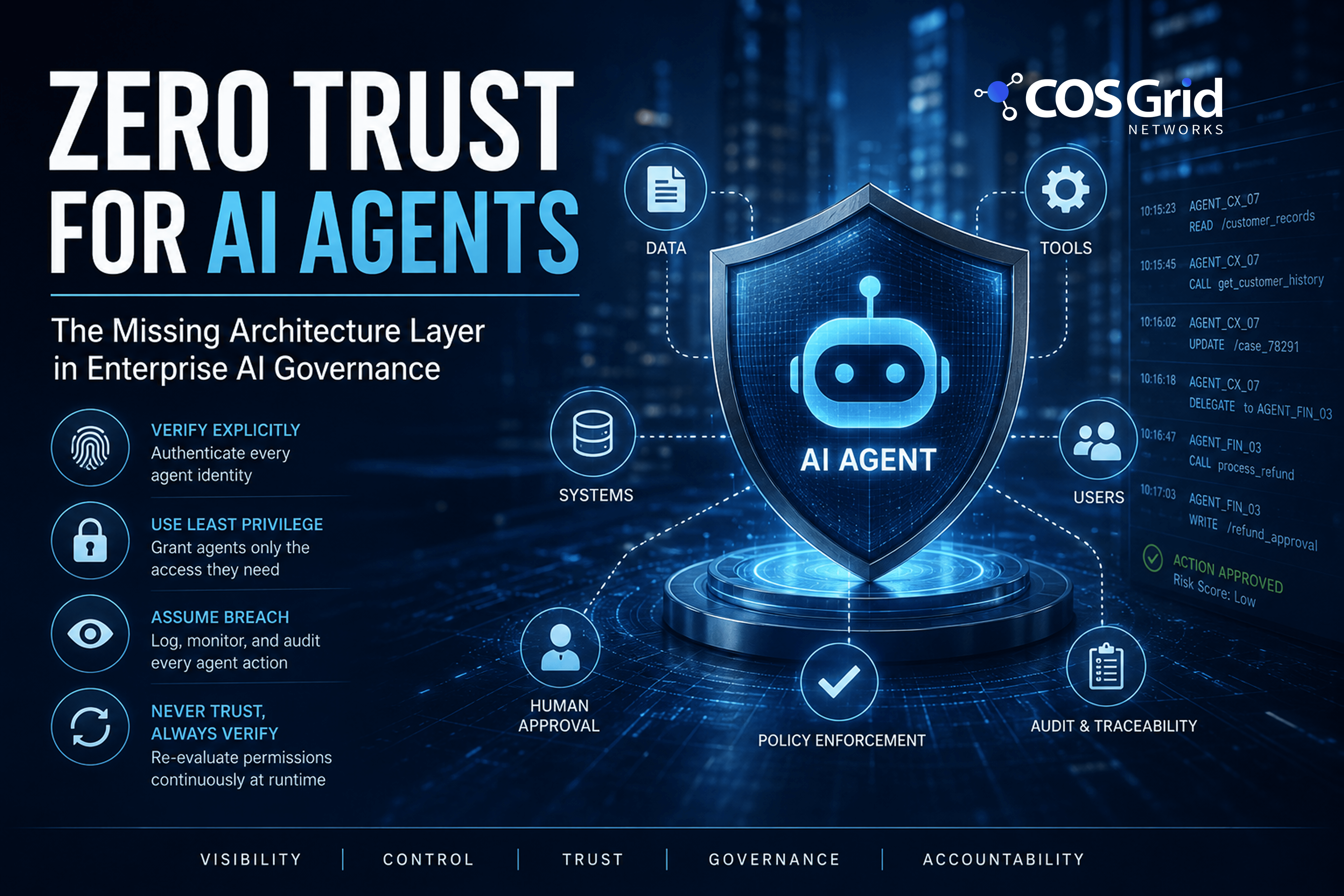
Zero Trust for AI Agents
The Missing Architecture Layer in Enterprise AI Governance
|
EXECUTIVE SUMMARY AI agents are not passive tools. They read data, interpret intent, call tools, trigger workflows, delegate to other agents, and generate outputs at machine speed. Traditional AI governance frameworks tell you what to govern. Zero Trust for AI Agents is the operating architecture that tells you how — agent by agent, action by action, in real enterprise environments. |
1. The AI Governance Problem No Framework Fully Solves
Enterprises deploying AI today are not short on frameworks. NIST AI RMF, ISO/IEC 42001, CSA AI Controls Matrix, OWASP LLM Top 10, MITRE ATLAS, and the EU AI Act all offer structured guidance for governing AI risk. Most security and compliance teams are already tracking at least two or three of these.
And yet, a critical gap persists: how do you actually enforce these frameworks at the point of AI action? That question becomes urgent when AI agents enter the picture.
2. What Makes AI Agents Fundamentally Different
Traditional security models are built around a familiar question: Is this user allowed to access this application? AI agents break that model entirely. They are autonomous actors that can:
• Read files, emails, databases, and APIs without human confirmation
• Interpret and act on unstructured instructions
• Call tools and trigger workflows at machine speed
• Delegate tasks to other agents in multi-agent chains
• Retain memory and context across sessions
• Generate and act on outputs faster than any human review cycle
When an AI agent is connected to your CRM, your code repository, your ticketing system, or your cloud infrastructure, the security question transforms. It is no longer "Is this user authorised?" It becomes:
"Is this agent allowed to take this action, using this data, through this tool, on behalf of this user, under this context, with this level of risk?"
3. Zero Trust for AI Agents: An Operating Architecture, Not Another Framework
It is tempting to view Zero Trust for AI Agents as yet another item on an already crowded compliance checklist. It is not. Existing AI governance frameworks are the policy layer — they define what principles matter: fairness, transparency, security, auditability. Zero Trust for AI Agents is the architecture layer — it defines how to enforce those principles in real enterprise environments.
Most CXOs already understand Zero Trust in the context of users, devices, networks, and applications. The same principles extend naturally to AI agents:
|
Zero Trust Principle |
Applied to AI Agents |
|
Verify explicitly |
Authenticate every agent identity before granting access |
|
Use least privilege |
Grant agents only the tools and data needed for each task |
|
Assume breach |
Log, monitor, and audit every agent action as if compromise is possible |
|
Never trust, always verify |
Re-evaluate agent permissions at runtime, not just at deployment |
4. The Risk Surface: Where AI Agents Create New Exposure
Shadow AI and sanctioned AI diverge
Employees across every function are already using public AI tools — ChatGPT, Gemini, Copilot — with corporate data, often without IT visibility. The risk is not just data leakage. It is the complete absence of any governance trail.
SaaS AI tools embed agent capabilities
Copilot for Microsoft 365, Salesforce Einstein, ServiceNow Now Assist, and Glean all include agentic features that summarise emails, draft responses, update records, and route tickets. These capabilities often arrive inside tools already deployed in production, bypassing traditional security review cycles.
Internal agent development is accelerating
Teams building with LangGraph, AutoGen, CrewAI, or Copilot Studio are creating agents that interact with internal systems. Development speed frequently outpaces security review, especially when agents are wired directly to databases, code repositories, or production APIs.
Multi-agent chains multiply the risk surface
When one agent delegates to another — and that agent calls a third — the original authorisation context can become detached from the actions being taken. Each hop in the chain is a potential point of failure.
5. When Should Enterprises Start?
The short answer: now, if any of the following apply.
• Employees are using public AI tools with corporate data — even informally or in productivity workflows.
• SaaS AI tools are being evaluated or deployed — Copilot, Gemini Workspace, Einstein, ServiceNow Now Assist, or Glean.
• Teams are building internal agents using LangGraph, AutoGen, CrewAI, or similar frameworks.
• Agents are connected to internal systems — email, files, CRM, code, ticketing, databases, or cloud APIs.
• The organisation operates in a regulated sector where auditability, data residency, consent, and incident materiality carry legal weight.
Regulated industries — financial services, healthcare, critical infrastructure, government — face additional urgency. When an AI agent reads patient data, modifies a trade record, or triggers a workflow in an operational system, the auditability requirements are the same as for a human employee. Often higher.
6. A Practical Starting Point: Discover, Classify, Govern, Control
Implementing Zero Trust for AI agents does not require replacing existing infrastructure. It starts with visibility and builds toward control.
Priority 1: Discover
Map where AI is being used — sanctioned tools, shadow AI, and agent workflows under development. You cannot govern what you cannot see.
|
Actions ▸ Enumerate all AI tools in use, sanctioned and shadow ▸ Identify which teams are building or evaluating agents ▸ Map third-party AI integrations and their data access scopes |
Priority 2: Classify
Identify the data, tools, and workflows that AI agents have access to. Not all AI use carries equal risk. An agent summarising internal meeting notes is different from one with write access to a production database.
|
Actions ▸ Classify data sensitivity across all AI-accessible stores ▸ Categorise agent capabilities: read-only vs write vs execute vs delegate ▸ Identify high-risk workflows that require human approval gates |
Priority 3: Govern
Define and enforce policy around sanctioned AI access. Which agents are approved? What data can they touch? What tools can they call? Policy without enforcement is aspiration.
|
Actions ▸ Define an approved agent registry with explicit capability boundaries ▸ Implement policy enforcement at the API and tool layer ▸ Establish logging requirements for all agent actions |
Priority 4: Control
Apply Zero Trust controls to agent actions at runtime.
|
Controls ▸ Identity: Every agent has a verifiable identity, not just a shared API key ▸ Least agency: Agents receive only the permissions needed for the specific task, revoked when the task ends ▸ Traceability: Every action is logged with full context — who authorised it, what data was accessed, what was produced ▸ Human approval gates: High-risk or irreversible actions require human confirmation before execution |
7. How Zero Trust for AI Agents Complements Existing Frameworks
Rather than competing with established AI governance frameworks, Zero Trust for AI Agents maps directly onto them:
|
Framework |
What it provides |
What Zero Trust adds |
|
NIST AI RMF |
Identifies AI risks |
Controls to mitigate them at the agent layer |
|
ISO/IEC 42001 |
Sets management system requirements |
Access and audit architecture to satisfy them |
|
OWASP LLM Top 10 |
Catalogues vulnerabilities |
Controls that limit the blast radius of each |
|
MITRE ATLAS |
Models adversarial AI threats |
Reduces the attack surface those threats exploit |
|
EU AI Act |
Mandates transparency and human oversight |
Approval gates and audit trails that operationalize mandates |
The frameworks define what good looks like. Zero Trust for AI Agents is how you get there.
8. The Question Enterprises Will Be Asking
The question is no longer: "Do we allow AI?" That ship has sailed. AI is already inside most enterprises, through productivity tools, SaaS platforms, and internal development projects.
The real question — the one every CISO, CTO, and board will be confronting within the next twelve to eighteen months — is:
"Which AI actors do we trust, for what purpose, under whose authority, with what data, through which tools, and with what proof?"
Zero Trust for AI Agents is the architecture that makes that question answerable.