On this page
How MicroZAccess WorksMesh ZTNA
What Is Mesh ZTNA?Zero Trust Principles
Connectivity Is Not AuthorizationArchitecture
MicroZAccess ArchitectureAccess Workflow
How Access Requests WorkIdentity
Identity & AuthenticationDevice Trust
Device Trust & ContextPolicy
Policy & Least PrivilegeApplication Access
MicrosegmentationContinuous Enforcement
Continuous EnforcementVPN Comparison
MicroZAccess vs VPNDirect Connectivity
Direct App ConnectivityDefault-Deny
Access Denial & Default-DenyControl Plane
Control Plane & Data PathMonitoring
Monitoring & VisibilityUse Cases
Common Use CasesUser Journey
Example User JourneySecurity Principles
Security PrinciplesFAQ
Common QuestionsKey Takeaways
Key TakeawaysHow it works: COSGrid MicroZAccess
Category comparison and positioning guide
01 — OVERVIEW
How MicroZAccess works?
COSGrid MicroZAccess is an agent-based Zero Trust Network Access (ZTNA) solution built around a peer-to-peer Mesh ZTNA architecture. Instead of treating network connectivity as proof of trust, MicroZAccess evaluates whether a specific identity, using a specific device, under applicable security conditions, should be allowed to access a specific application or resource.
The core principle is simple: connectivity is not authorization. A user being connected to an access environment does not automatically grant access to the surrounding network. MicroZAccess applies identity-driven, application-specific access so users receive only the resources explicitly permitted by policy.
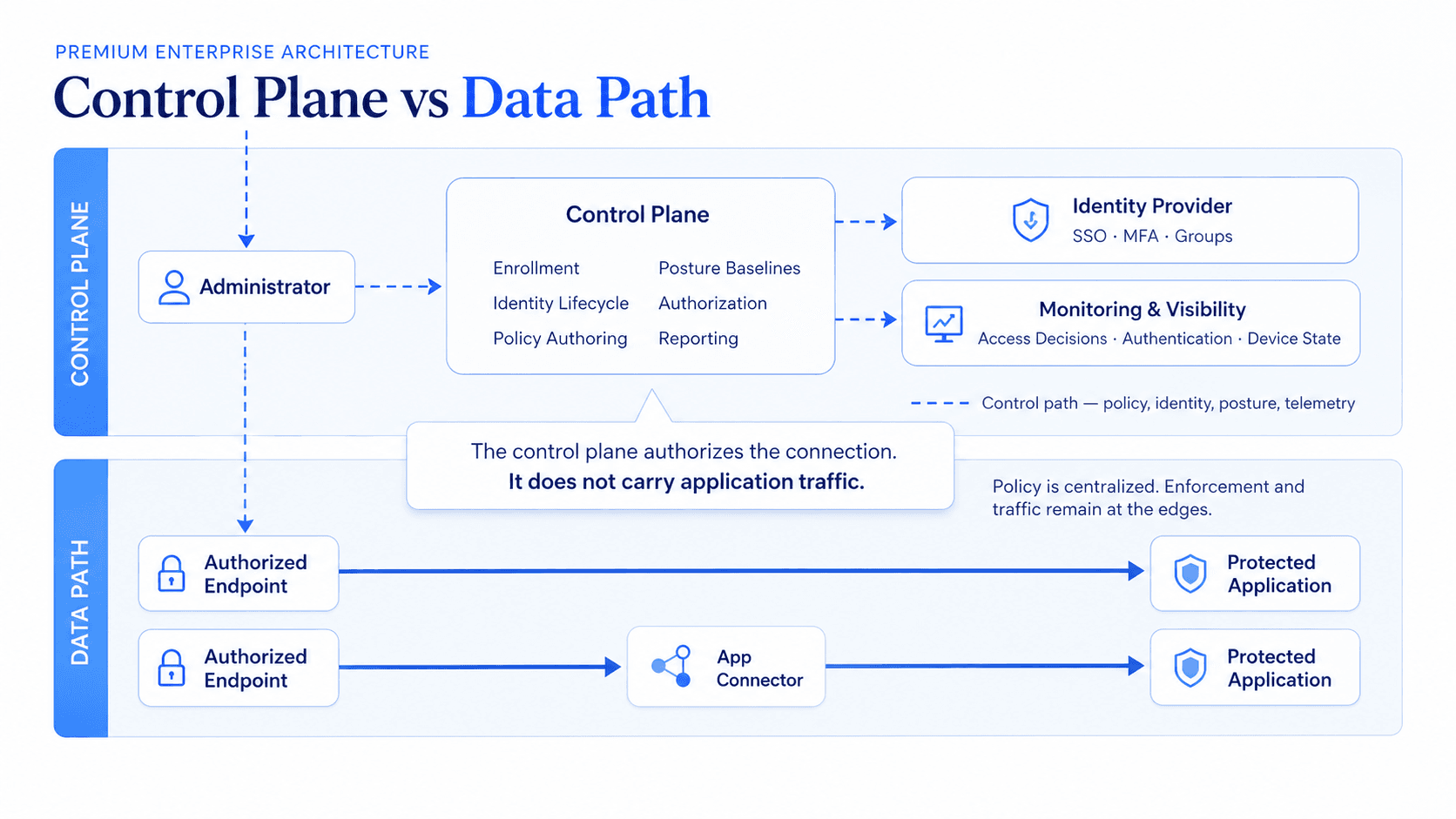
MicroZAccess separates centralized access management from the application data path. Policies and access controls are managed centrally, while authorized application traffic uses a direct encrypted connection between the authorized endpoint and the protected resource. This supports least-privilege access, application-level segmentation, and reduced unnecessary network exposure.
02 — MESH ZTNA FUNDAMENTALS
What is Mesh ZTNA?
Mesh ZTNA is an approach to Zero Trust Network Access in which authorized endpoints and protected resources can communicate directly over an encrypted peer-to-peer access fabric. Instead of placing a centralized traffic broker in the path of every application session, MicroZAccess uses centralized control to determine whether a connection is permitted and then establishes direct connectivity between authorized participants.
This distinction matters because the control plane governs identity, policy, device trust, and access decisions; it is not the mandatory path for application traffic. Once authorization is satisfied, the application session follows the direct authorized connection.
03 — ZERO TRUST PRINCIPLES
The Core Idea: Connectivity is not authorization
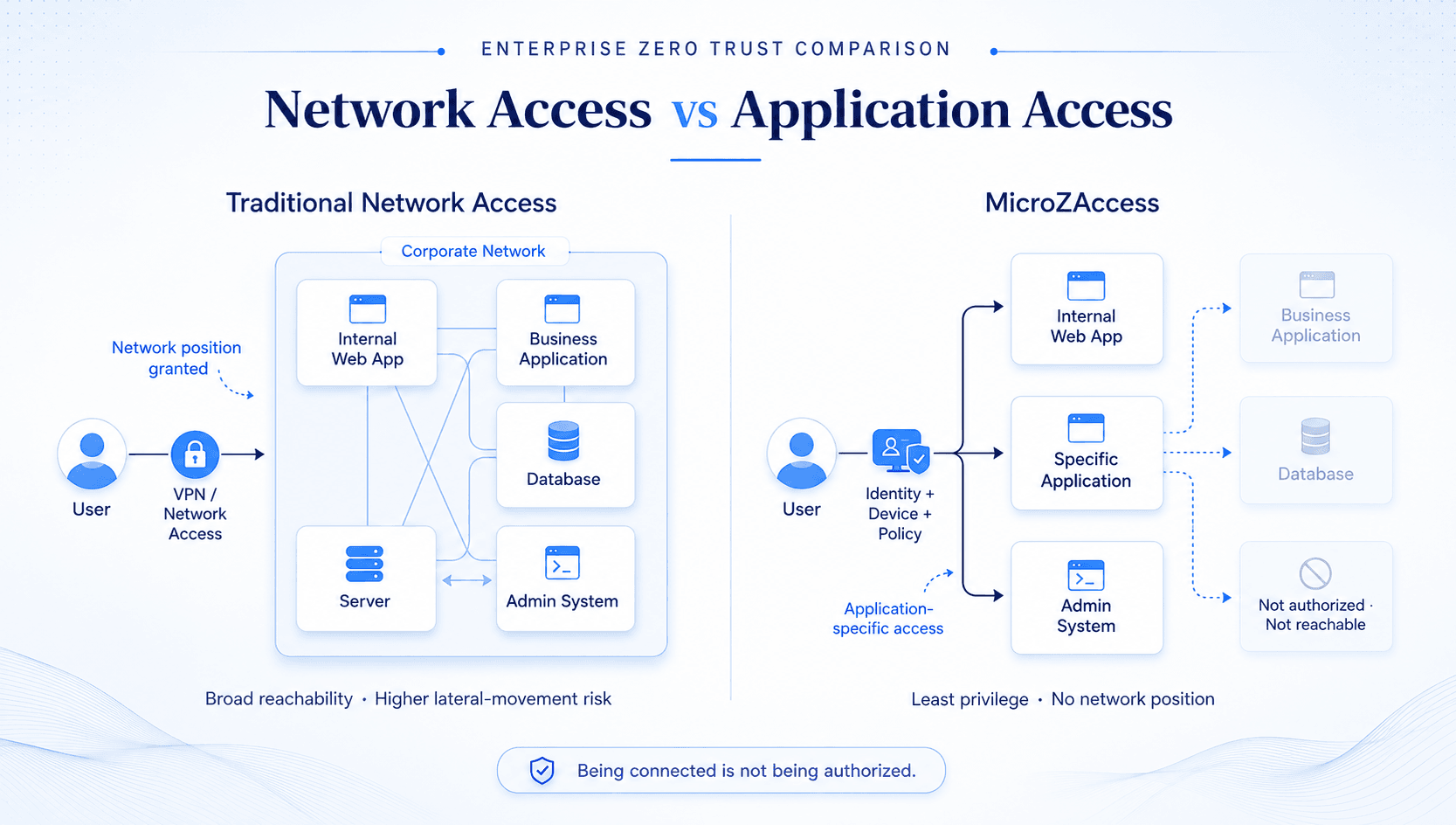
Traditional remote-access models commonly begin by establishing network connectivity. After a user connects, the reachable network can become the practical trust boundary. MicroZAccess starts with the application instead: should this identity, on this device, under these conditions, be allowed to access this particular resource?
04 — ARCHITECTURE AND COMPONENTS
MicroZAccess Architecture
MicroZAccess combines identity, endpoint trust, centralized policy management, and direct application connectivity. Its main public-facing components are described below.
05 — ACCESS REQUEST WORKFLOW
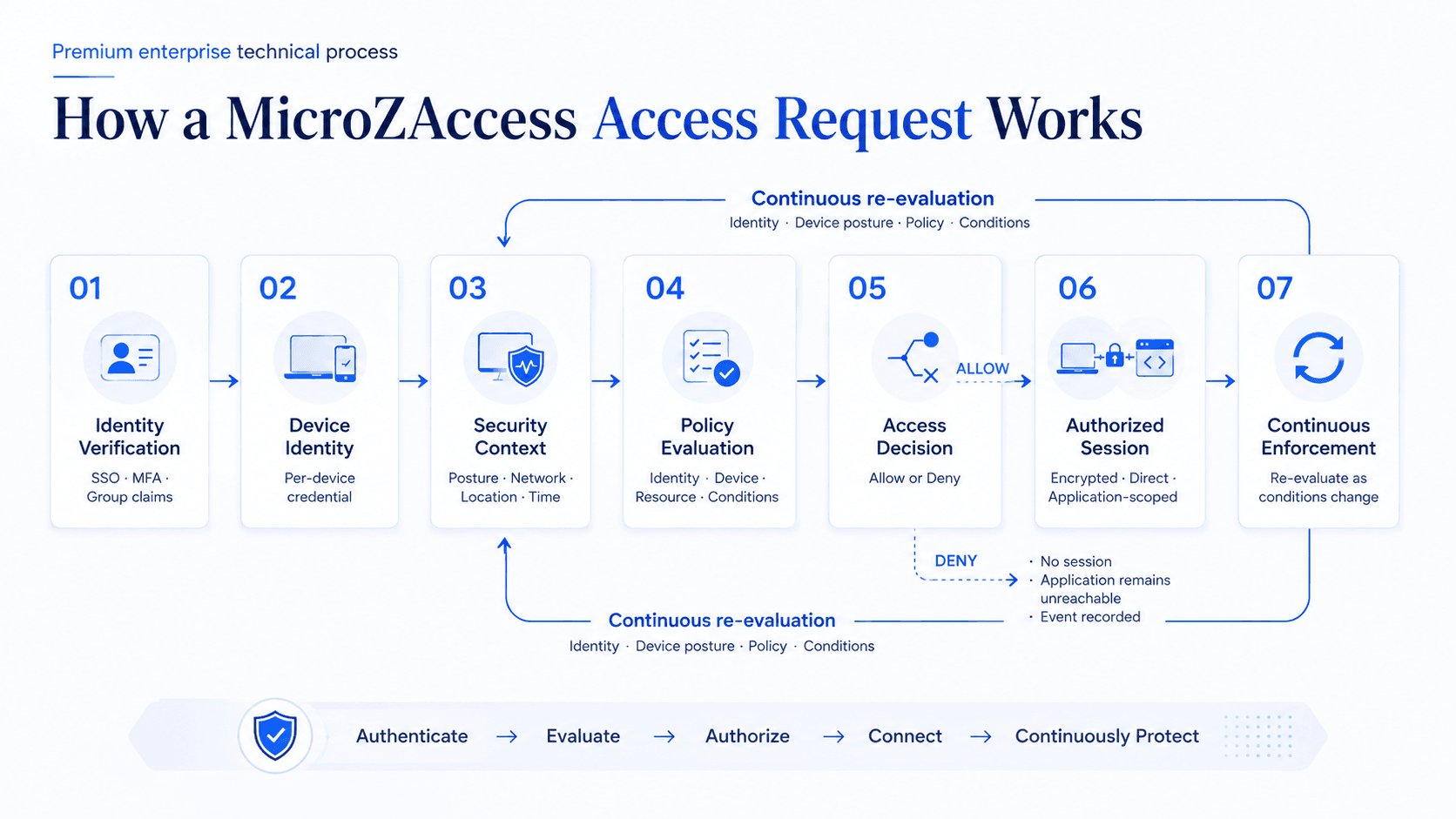
How a MicroZAccess access request works?
1. User initiates access
The user requests an internal application or protected resource.
2. Device is verified
The requesting endpoint is identified and its enrollment or trust state is considered.
3. Security context is evaluated
Applicable device posture and contextual conditions are evaluated against policy requirements.
4. Policy is evaluated
Identity, group or role, device, context, requested application, and policy conditions are evaluated together.
5. Access is authorized or denied
Only requests satisfying applicable policy are allowed.
6. Direct secure connection is established
When permitted, an encrypted direct connection is established between the authorized endpoint and the protected application or access point.
7. Enforcement continues
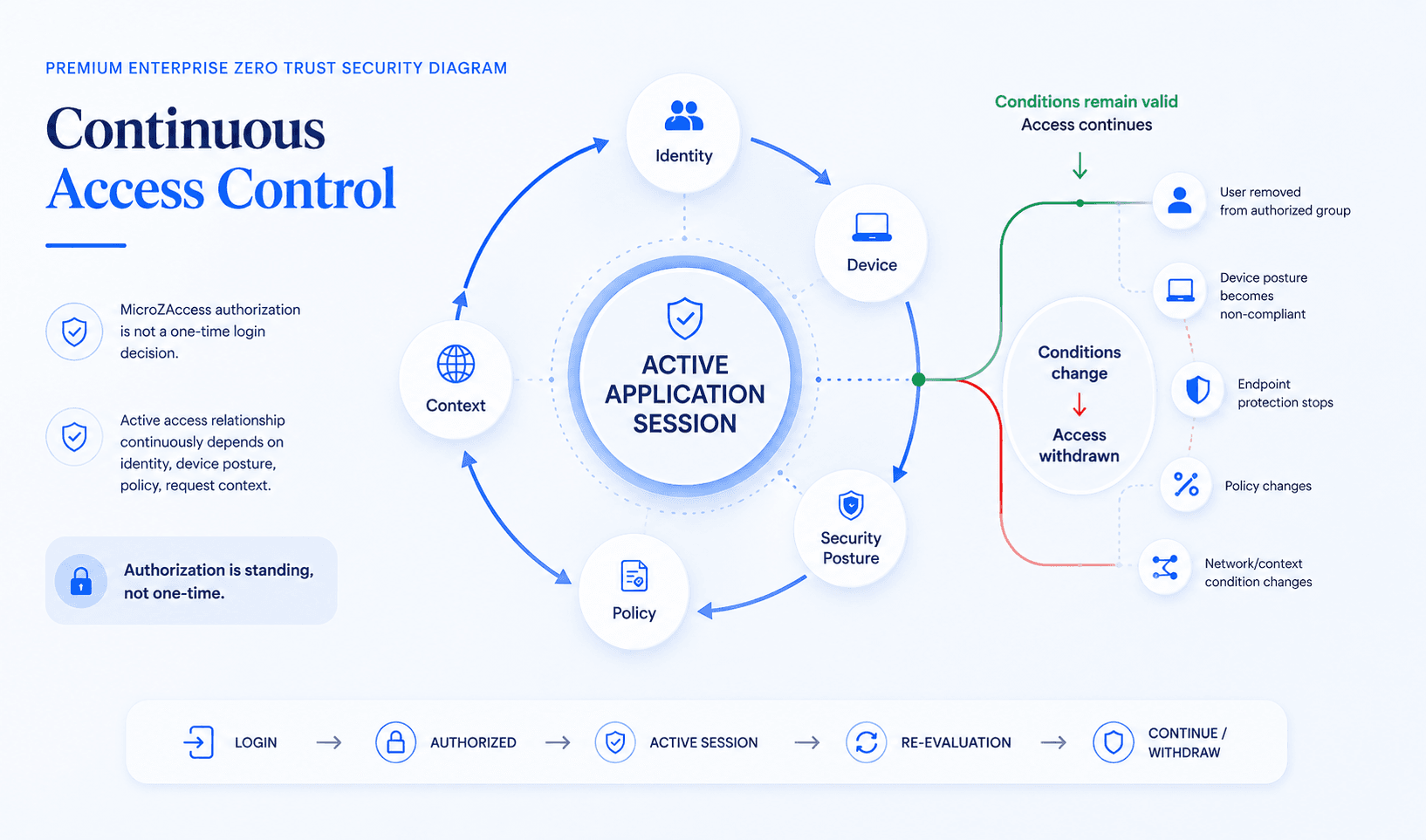
Changes in identity, device state, context, or policy can affect continued access.
06 — IDENTITY AND AUTHENTICATION
Identity Verification and Authentication
Identity is a fundamental input to Zero Trust access. MicroZAccess uses authenticated identity rather than network location as the primary basis for determining who is requesting an application. Organizations can use their existing Identity Provider and authentication controls.
07 — DEVICE TRUST AND CONTEXT-AWARE ACCESS
Device Trust and Security Context
User identity alone is not sufficient for Zero Trust access. MicroZAccess can incorporate device trust, security posture, and contextual information into access decisions. Exact signals depend on organizational configuration.
These signals can be combined differently for different applications. A sensitive application can require stronger device and contextual conditions than a lower-risk application.
08 — POLICY AND LEAST-PRIVILEGE ACCESS
Policy Evaluation and Least-Privilege Access
Policy converts Zero Trust principles into enforceable access controls. A MicroZAccess policy defines who can access a resource and the conditions that must be satisfied.
MicroZAccess follows a least-privilege approach: access is explicitly permitted rather than assumed from network membership. A user permitted to access one application does not automatically receive access to other applications simply because they share the same environment.
09 — APPLICATION ACCESS AND MICROSEGMENTATION
Application-Level Access and Zero Trust Microsegmentation
Microsegmentation limits unnecessary communication between identities, devices, applications, and resources. MicroZAccess makes the protected application the practical unit of access control, allowing organizations to define access around business resources rather than granting a broad network position.
10 — CONTINUOUS ENFORCEMENT
Continuous Zero Trust Enforcement
Zero Trust is not simply a login event. The conditions that justified access can change after authentication. MicroZAccess is designed to keep access aligned with applicable identity, device, context, and policy conditions.
11 — VPN VS ZERO TRUST ACCESS
MicroZAccess vs VPN: What is the difference?
The key difference is the access boundary. A traditional VPN commonly provides network-level connectivity after authentication. MicroZAccess focuses on application-specific connectivity governed by Zero Trust policy.
MicroZAccess can serve as a Zero Trust alternative to broad VPN access or be introduced alongside existing remote-access technologies during migration.
12 — DIRECT SECURE CONNECTIVITY
Direct Application Connectivity
After authorization, MicroZAccess establishes a direct encrypted connection between the authorized endpoint and the protected application or appropriate application access point. COSGrid Guider manages and governs access; it is not the mandatory path for application traffic.
This separation keeps application communication focused on the resource that policy permitted. Authorization to one application does not imply authorization to neighboring resources.
13 — ACCESS DENIAL AND DEFAULT-DENY BEHAVIOR
What happens, when access is denied?
The user requests a protected application.
The request is evaluated against identity, device, context, and policy.
If required conditions are not satisfied, access is denied.
No authorized application connection is established.
The event can be recorded for visibility, investigation, and auditing.
Default-deny behavior means that an unauthorized resource does not need a separate rule for every user. If access has not been explicitly permitted, it remains outside the user's authorized application scope.
14 — CONTROL PLANE AND DATA PATH
Control Plane and Application Data Path
Centralized management governs access, while authorized application traffic follows the direct connection established for the permitted resource.
15 — MONITORING AND VISIBILITY
Monitoring and Visibility
Visibility helps security teams understand how Zero Trust policies operate and investigate access outcomes.
A useful access record should help answer: Who requested access? Which application was requested? When did it happen? Was access allowed or denied? Which policy or condition affected the decision?
16 — USE CASES
Common MicroZAccess Use Cases
Identity-driven access to internal applications without treating remote connectivity as broad network trust.
Introduce application-specific Zero Trust access while reducing dependence on broad network-level remote access.
Limit users and devices to the applications and resources required for their roles.
Protect selected workloads and internal services across distributed environments.
Apply consistent identity and application access principles across on-premises and cloud resources.
Provide scoped access to required applications while reducing unnecessary exposure to other resources.
17 — USER JOURNEY
Example User Journey
Consider a finance employee who needs a loan-processing application and an internal analytics platform but does not need engineering or HR systems.
The employee signs in through the organization's IdP and completes configured authentication.
MicroZAccess verifies identity and relevant group or role information.
The endpoint's trust and applicable security context are evaluated.
Policy checks whether the user and device satisfy requirements for each requested application.
Access is granted only to explicitly permitted applications.
Unrelated applications remain outside the authorized access scope.
If identity, device state, context, or policy changes, access can be reevaluated and adjusted.
18 — SECURITY PRINCIPLES
Security Principles behind MicroZAccess
Verify identity: Use authenticated identity as a primary access signal.
Verify the device: Consider the trust and security state of the requesting endpoint.
Apply least privilege: Grant only the application access required for the user's role.
Do not trust network location alone: A corporate network connection should not automatically imply application access.
Make the application the access boundary: Control access to specific resources instead of granting broad network reachability.
Continuously enforce: Keep access aligned with changing identity, device, context, and policy conditions.
Default to deny: Access that is not explicitly permitted should not be available.
Maintain visibility: Record access activity and decisions so security teams can investigate and audit them.
19 — FREQUENTLY ASKED QUESTIONS
Frequently Asked Questions about MicroZAccess

What is MicroZAccess?
COSGrid MicroZAccess is an agent-based Zero Trust Network Access solution that provides identity-driven, application-specific access using user identity, device trust, security context, and policy.
How does MicroZAccess work?
MicroZAccess verifies identity, evaluates the requesting device and applicable context, checks policy for the requested application, and establishes access only when the required conditions are satisfied.
How is MicroZAccess different from a VPN?
A traditional VPN commonly provides network-level connectivity after authentication. MicroZAccess focuses on application-level access so users receive only resources permitted by Zero Trust policy.
Does MicroZAccess support application-level access?
Yes. Application-specific access is a core part of the MicroZAccess Zero Trust model.
What is Zero Trust microsegmentation?
Zero Trust microsegmentation limits access between identities, devices, applications, and resources so users receive only the connectivity required for their role.
Does MicroZAccess use device posture?
MicroZAccess can use device trust and security posture as inputs to access policy, allowing organizations to consider endpoint security state when granting application access.
Does MicroZAccess support MFA?
MicroZAccess can use multi-factor authentication through the organization's configured identity and authentication controls.
Can MicroZAccess replace a VPN?
MicroZAccess can be used as a Zero Trust alternative to broad VPN-based application access or alongside existing remote-access technologies during migration.
Why is least-privilege access important?
Least privilege reduces unnecessary reachability. If an identity is compromised, limiting access to required applications can reduce the potential scope of unauthorized activity.
What happens when a user is not authorized?
The requested access is denied and no authorized connection to the protected resource is established. Access activity can also be recorded for visibility and investigation.
20 — KEY TAKEAWAYS
Key Takeaways

Connectivity is not authorization. Joining the access environment does not automatically provide application access.
Identity, device, security context, policy, and the requested application can be considered together when determining access.
MicroZAccess applies least-privilege, application-specific access rather than broad network access.
Application-level access supports Zero Trust microsegmentation and helps reduce unnecessary lateral movement
Device trust and security posture can strengthen access decisions beyond user authentication alone.
Continuous enforcement helps keep access aligned with changing identity, device, context, and policy conditions.
Authorized application traffic uses a direct encrypted connection rather than a mandatory centralized traffic path.
Centralized policy management and distributed enforcement provide a scalable way to govern application access.