5 Emerging Zero Trust Network Access Trends Shaping Enterprise Security in 2025



The Zero Trust Revolution: Why Traditional Security Models Are Failing
Did you know that despite having traditional perimeter-based security measures in place, the number of cyber-attacks rose by 30% in 2024, reaching an average of 1,636 weekly attacks per organisation? This staggering statistic underscores a critical reality: the conventional "castle and moat" approach to cybersecurity is no longer sufficient in today's threat landscape.
The cybersecurity landscape continues to evolve at breakneck speed, and traditional perimeter-based security models are proving inadequate against sophisticated modern threats. As we navigate through 2025, Zero Trust Network Access (ZTNA) has emerged as the cornerstone of enterprise security strategies, fundamentally changing how organizations approach network security.
What You'll Learn:
- Why traditional security models are no longer effective in 2025
- How Zero Trust Network Access (ZTNA) is evolving to address complex threats
- Five emerging trends that are redefining enterprise cybersecurity
- How to extend Zero Trust to IoT, edge devices, and hybrid workforce
- The role of AI and behavioral analytics in enabling continuous authentication
- Actionable steps to implement a unified, scalable Zero Trust framework
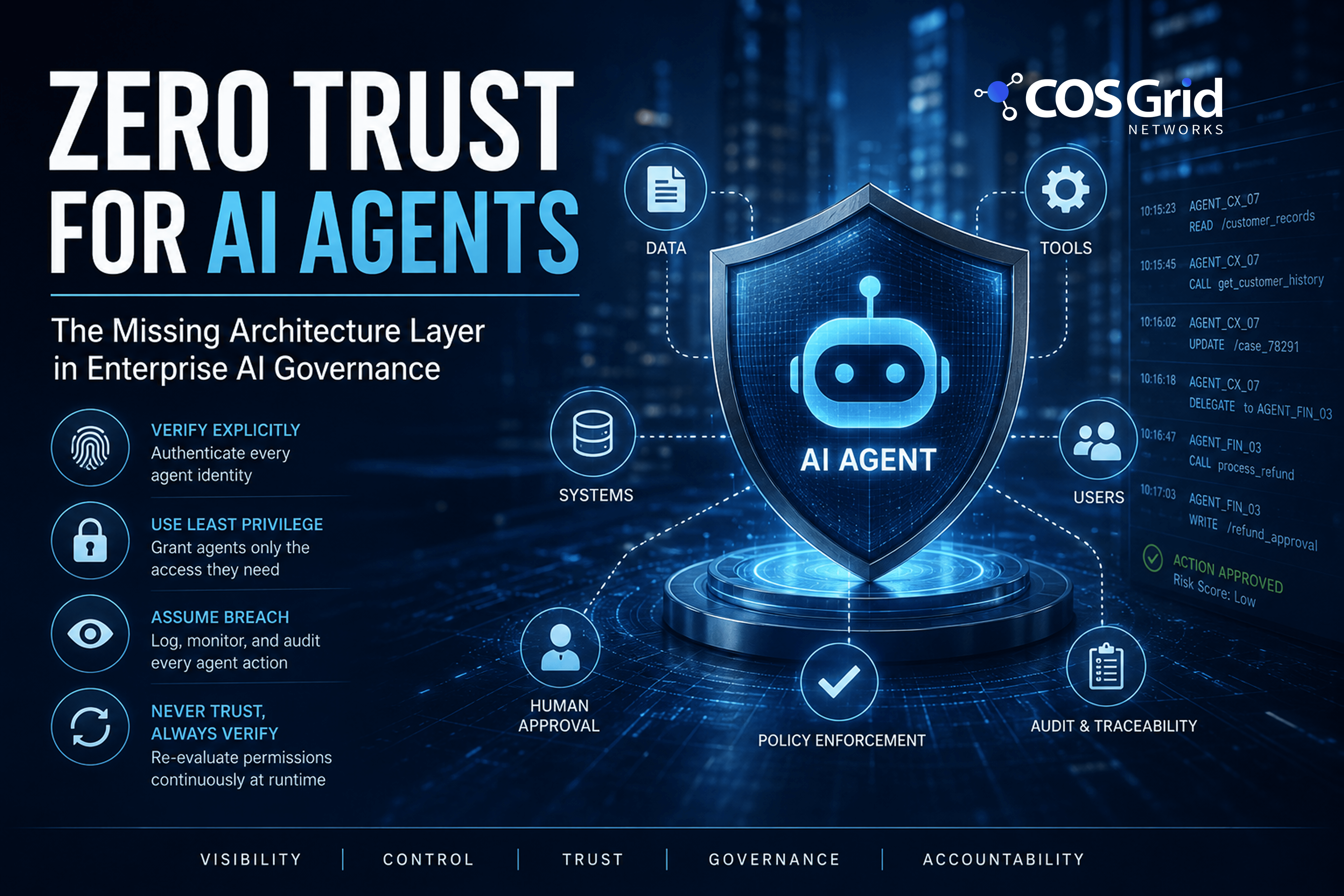
Unlike conventional VPNs that grant broad network access based on location, ZTNA operates on the principle of "never trust, always verify," ensuring that every connection is authenticated, authorized, and encrypted. At COSGrid Networks, we've observed a significant shift in how enterprises are implementing ZTNA solutions, with organizations achieving measurable security improvements and operational efficiencies.
Trend 1: ZTNA-Integrated Network Access Control (NAC) - Bridging Device Security and Access
The Critical Gap in Traditional Security Models
The integration of Zero Trust Network Access (ZTNA) with Network Access Control (NAC) is rapidly emerging as a critical security strategy for enterprises in 2025. Traditional security models that rely on perimeter-based defenses are failing to address the sophisticated cyber threats targeting digital assets across hybrid cloud environments. This convergence allows organizations to enforce granular access policies not just at the user and application level, but also at the device and network level, ensuring only trusted, compliant devices can connect to corporate resources - whether on-premises, cloud, or remote.
The Rise of Device-Centric Security
As organizations manage increasingly complex digital ecosystems, the need for continuous monitoring and device compliance verification has become paramount. ZTNA NAC solutions provide real-time visibility, continuous device compliance checks, and automated enforcement, making them indispensable for modern, hybrid work environments where traditional security models simply cannot keep pace with emerging cyber threats.
Key Security Challenges Addressed:
- Device Trust Verification: Ensuring every device meets security standards before accessing digital assets
- Continuous Compliance Monitoring: Real-time assessment of device posture and security status
- Multi-Factor Authentication Integration: Combining device trust with user identity verification
- Cloud Security Consistency: Unified policy enforcement across cloud environments and on-premises infrastructure
Looking to future-proof your security stack?
Our resource library covers ZTNA and secure access concepts.
Trend 2: Unified SASE and ZTNA Convergence - The Future of Network Security Architecture
Breaking Down Security Silos
The convergence of Secure Access Service Edge (SASE) with Zero Trust Network Access (ZTNA) is a dominant trend shaping enterprise security in 2025. As cyber threats become increasingly sophisticated and target digital assets across distributed cloud environments, organizations are seeking unified platforms that combine network security and wide-area networking into a single cloud-delivered service.
Traditional security models that rely on disparate point solutions are proving inadequate against modern attack vectors. The integration of SASE with ZTNA provides consistent security policies and enhanced visibility across all edges-remote users, cloud applications, and branch offices-while incorporating robust multi-factor authentication mechanisms and continuous monitoring capabilities.
The Business Case for Convergence
Organizations implementing unified SASE and ZTNA platforms report significant operational improvements, with a majority of them experiencing reduced complexity in managing cloud security across multiple cloud environments. This convergence enables seamless, secure access for hybrid workforces and multi-cloud environments, dramatically improving management efficiency while strengthening protection of digital assets.
Unified Platform Benefits:
- Consistent Policy Enforcement: Single pane of glass management across all cloud environments
- Enhanced Threat Visibility: Comprehensive monitoring of cyber threats across distributed infrastructure
- Simplified Multi-Factor Authentication: Integrated identity verification across all access points
- Streamlined Cloud Security: Unified protection for digital assets regardless of location
Trend 3: Zero Trust Network Access for IoT and Edge Devices in 2025
As enterprises embrace digital transformation, the proliferation of IoT and edge devices presents new security challenges. Traditional perimeter defenses fall short in environments where thousands of devices operate beyond centralized control. In 2025, Zero Trust Network Access (ZTNA) is extending its reach to secure these distributed endpoints—bringing identity-first protection, encrypted communications, and real-time behavioral monitoring to the edge. - Itha potudunga
Key Developments:
- Device Identity Everywhere: Every IoT device, no matter how limited its resources, is assigned a unique, verifiable identity. Lightweight identity proxies ensure strong authentication and authorization without bogging down device performance.
- Microsegmentation: Networks are divided into isolated zones for different device categories---such as environmental sensors, cameras, and industrial controllers. This approach can reduce the attack surface by up to 65%, preventing attackers from moving laterally if one segment is compromised.
- Encrypted Communications: All data transmitted by IoT devices is encrypted using advanced protocols like TLS 1.3, safeguarding data integrity and confidentiality from the edge to the cloud.
- Continuous Monitoring: ZTNA solutions continuously analyze device behavior and network traffic, rapidly detecting anomalies and enforcing dynamic access policies.
Why It Matters:
By extending Zero Trust principles to IoT and edge environments, organizations gain granular control and robust security, protecting critical infrastructure and sensitive data from the ever-evolving threat landscape.
Trend 4: Peer-to-Peer Direct Connectivity and Hybrid Architecture - Optimizing Performance and Security
Revolutionizing Remote Access Architecture
The demand for faster, more secure, and resilient remote access is driving widespread adoption of peer-to-peer direct connectivity within ZTNA solutions. Traditional security models that route all traffic through centralized gateways create bottlenecks and single points of failure, making digital assets vulnerable to both performance degradation and cyber threats.
This innovative approach minimizes latency, improves user experience, and enhances cloud security by establishing encrypted tunnels directly between endpoints, bypassing traditional VPN bottlenecks while maintaining continuous monitoring and multi-factor authentication requirements.
Hybrid Architecture Advantages
Modern cyber threats require flexible, adaptive security architectures that can respond to changing network conditions and threat landscapes. Hybrid architectures that support both direct and relayed connections are becoming essential for organizations with complex cloud environments and distributed digital assets.
Performance and Security Benefits:
- Reduced Latency: Direct connections improve application performance by up to 40%
- Enhanced Resilience: Multiple connection paths reduce single points of failure
- Improved Cloud Security: Encrypted peer-to-peer tunnels provide superior protection for digital assets
- Flexible Deployment: Adaptive connectivity based on network conditions and security requirements
The Technical Innovation Behind Direct Connectivity
Advanced peer-to-peer architectures incorporate sophisticated security mechanisms that surpass traditional security models. These systems maintain continuous monitoring capabilities while enabling direct connections, ensuring that multi-factor authentication and device compliance verification occur seamlessly without impacting performance.
Trend 5: AI-Driven Behavioral Analytics and Continuous Authentication
Beyond Static Security Policies
The final trend reshaping ZTNA in 2025 is the integration of artificial intelligence and machine learning into network access decisions. Rather than relying solely on static policies, modern ZTNA solutions are implementing continuous behavioral analysis to detect anomalies and adapt access permissions in real-time.
Advanced Behavioral Profiling
These AI-driven systems analyze patterns in user behavior, device characteristics, application usage, and network traffic to build baseline profiles for each entity requesting access. When deviations from normal patterns are detected-such as unusual login times, unexpected application access, or abnormal data transfer volumes-the system can automatically adjust access permissions or require additional verification.
AI-Powered Security Features:
- Machine learning-based user behavior analytics (UBA)
- Contextual risk scoring using multiple data points
- Automated policy adjustment based on threat intelligence
- Predictive threat modeling for proactive security measures
Contextual Risk Assessment
The sophistication of these systems extends to contextual risk assessment, where factors like geolocation, device health, application sensitivity, and current threat intelligence are combined to calculate dynamic risk scores. Access decisions are then made based on these real-time assessments rather than predetermined rules.
This approach addresses the reality that security threats are constantly evolving, and static policies cannot keep pace with adaptive adversaries. By implementing continuous authentication and behavioral analytics, organizations can maintain security without sacrificing user experience, automatically adjusting security requirements based on actual risk rather than broad categories.
It is truly interesting to note that AI-powered security systems can reduce false positives by up to 37% in practical deployments, with significant improvements in threat detection and operational efficiency.
The Future of Enterprise Network Security: Your Next Steps
These five trends represent more than incremental improvements to existing technologies-they signal a fundamental transformation in how organizations approach network security. The convergence of device-centric security, IoT integration, unified platform approach and AI-driven analytics creates a comprehensive security ecosystem that adapts to modern threat landscapes.
Key Takeaways for 2025:
- Device-Centric Security: Integrate NAC with ZTNA for comprehensive device trust and continuous monitoring
- IoT Integration: Prepare for billions of connected devices with lightweight, scalable authentication
- Unified Platform Approach: Converge SASE and ZTNA for streamlined cloud security management
- Performance Optimization: Deploy hybrid connectivity for enhanced user experience and security
- AI-Powered Adaptation: Deploy behavioral analytics for continuous, context-aware security
The Competitive Advantage of Early Adoption
For enterprises planning their 2025 security strategies, the message is clear: ZTNA is no longer just about replacing VPNs or implementing basic access controls. It's about creating intelligent, adaptive, and measurable security architectures that protect against sophisticated threats while enabling business agility.
Organizations that embrace these emerging trends will find themselves not only more secure but also more efficient, more compliant, and better positioned to demonstrate the business value of their security investments. As we continue through 2025, ZTNA will evolve from a security necessity to a competitive advantage, enabling enterprises to operate securely in an increasingly connected and complex digital landscape.
The question for enterprise leaders is not whether to adopt these trends, but how quickly they can implement them to stay ahead of evolving threats and capture the operational and financial benefits they provide.
Transform Your Security Posture with COSGrid
Ready to implement these cutting-edge ZTNA trends in your organization? COSGrid's comprehensive Zero Trust platform combines all five trends into a single, integrated solution that scales with your business needs.
Schedule a Personalized COSGrid Demo to see how our platform can transform your security architecture.
Not sure where to start with Zero Trust implementation?
Our ZTNA FAQ page covers everything from deployment steps to common challenges.
Additional Resources:
- Get started with our Setup & Configuration Demo Guide
- Contact a COSGrid Security Expert for a personalized consultation
- Explore COSGrid ZTNA Solutions for detailed product information
Share this article:





Explore Related Articles:
Five Aspects of Zero Trust Network Access (ZTNA) that Business VPN users might be unaware
About Author
Murugavel Muthu