


COSGrid Network DLP | Network Data Loss Prevention

Data Protection for the Devices You Can't Put an Agent On

Protect unmanaged and branch devices through intelligent network-based data loss prevention.

Key Highlights

Agentless Network-Path Inspection

Agentless Network-Path Inspection

Designed for branch and unmanaged devices

Allow, Block & Alert Policies

Allow, Block & Alert Policies

web upload inspection with policy-based actions

Centralised Visibility

Centralised Visibility

Incident visibility through COSGrid Guider

What is COSGrid Network DLP?

COSGrid Network DLP is a agentless network data loss prevention solution designed to extend data protection beyond managed endpoints. By inspecting data moving through the network, it aims to identify sensitive information from branch computers, shared terminals, contractor laptops and other devices that cannot run the MicroZ Client, apply policy-based controls, and provide centralised incident visibility through COSGrid Guider.

How Network DLP Works

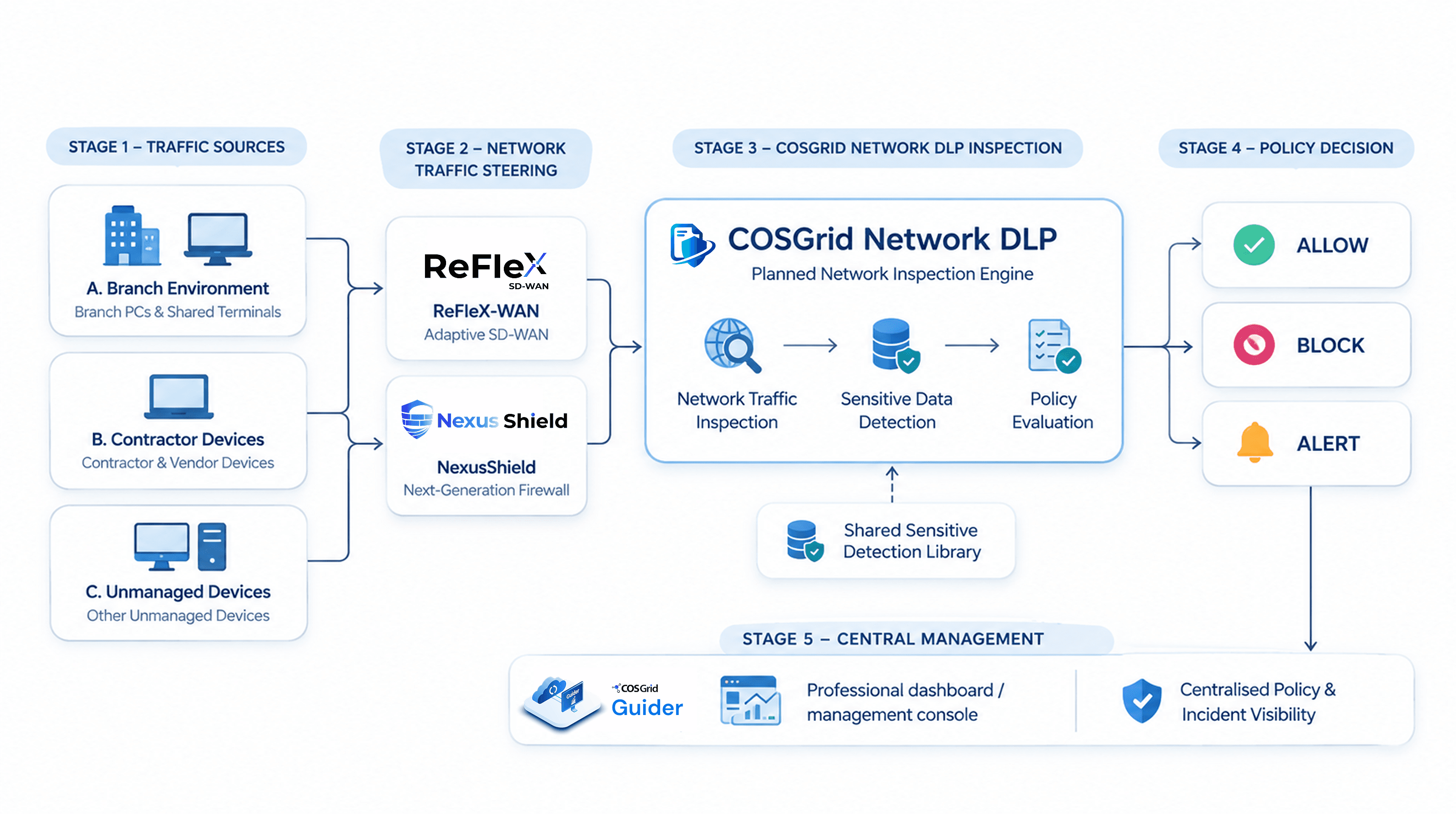
Proposed Network DLP architecture showing branch and unmanaged traffic reaching central inspection and policy visibility

Features

Designed to bring unmanaged devices into data protection

Network-Path Data Inspection

  • Designed to inspect data from devices that cannot run the MicroZ Client, extending data protection visibility to devices that may otherwise remain outside endpoint-based controls.
  • Intended traffic sources include branch environments connected through ReFleX-WAN or NexusShield tunnels, as well as unmanaged and contractor devices.
  • Web uploads are the initial traffic inspection scope, with additional protocols intended to follow.
Network-Path Data Inspection

Device & Data Coverage

Designed for Devices Outside Endpoint Agent Coverage

Branch PCs and shared terminals

Branch PCs and shared terminals

  • Branch computers, counter terminals, kiosks and shared workstations that may not support individual endpoint agent deployment.
  • Intended traffic path: branch traffic through ReFleX-WAN or NexusShield tunnels.

Contractor and vendor-owned devices

Contractor and vendor-owned devices

  • Devices owned and managed by external vendors, contractors or business partners that access organisational resources.
  • Intended coverage: network-path inspection without installing the endpoint agent on third-party devices.

Other unmanaged devices

Other unmanaged devices

  • Devices that cannot or will not run the MicroZ Client but still participate in organisational data workflows.
  • Intended coverage: extend data inspection to supported traffic from these devices.

Intended data inspection

Intended data inspection

  • Designed to use the shared sensitive data detection library, including Indian identifiers.
  • Initial traffic scope: web uploads. Additional protocols are subject to development and validation.

Business Benefits

Extend Data Protection Across Your Network Environment

Agentless
Reduce unseen data movement
Bring devices without endpoint agents into the intended scope of data protection
Unmanaged
Improve device visibility
Identify sensitive data movement from branch, contractor and other unmanaged environments
Consistent
Apply consistent policies
Shared detection library supports consistent identification of sensitive data patterns
Centralise incident visibility
Network DLP incidents available in COSGrid Guider for central review
Extend protection across branches
Use ReFleX-WAN or NexusShield tunnels for intended branch traffic inspection
Address endpoint coverage gaps
Complement endpoint protection with inspection where agents cannot deploy
Compliance and data protection
Designed to support DPDP Act 2023, RBI IT Governance 2023 and ISO 27001:2022 Annex A 8.12 objectives; not certification.

Use cases

Designed for organisations with distributed and unmanaged devices

Extend data protection across branch environments

Extend data protection across branch environments

Branch PCs, shared counter terminals and other fixed-function devices may not be suitable for endpoint agent deployment. COSGrid Network DLP is designed to inspect supported branch traffic and identify sensitive data transfers through a network-path inspection approach.

Address data protection gaps across distributed locations

Address data protection gaps across distributed locations

Financial organisations often operate multiple branches and shared workstations. The solution aims to extend sensitive data inspection to supported traffic from devices that cannot run an endpoint agent.

Address data risks from contractor-owned devices

Address data risks from contractor-owned devices

External contractors and vendor personnel may use their own devices to access organisational data. COSGrid Network DLP is designed to provide network-path inspection for supported traffic from these unmanaged environments.

Extend data protection beyond managed devices

Extend data protection beyond managed devices

Organisations with existing endpoint controls may still have devices that cannot support agent deployment. The Network DLP approach aims to extend data protection visibility to these environments.

COSGrid Network DLP - FAQs

Have a question about Network DLP?

questionWhat is COSGrid Network DLP and why is it developed?
arrow
COSGrid Network DLP is a network data loss prevention solution designed to inspect data moving through the network and identify sensitive information from devices that cannot run an endpoint agent. Many organisations have branch PCs, shared terminals, contractor laptops and other unmanaged devices, and Network DLP is designed to extend data protection to these environments through network-path inspection.
questionWill Network DLP require an agent on individual devices?
arrow
No. No endpoint agent is intended to be required for the Network DLP inspection approach. The product is specifically designed for environments where the MicroZ Client cannot be deployed.
questionHow is network traffic intended to reach the inspection point?
arrow
Branch traffic is intended to reach the inspection point through ReFleX-WAN or NexusShield tunnels. The deployment model for other unmanaged devices remains subject to validation.