On this page
How TrustShield AI WorksAI Governance FundamentalsTrustShield AI ArchitectureHow It Works Step by StepShadow AI DiscoveryAI Application Access ControlAI-Related Data ProtectionAI Usage EnvironmentsOutbound API MonitoringGovernance ActionsPolicy ManagementExample User JourneyCommon Use CasesKey BenefitsFAQCOSGrid TrustShield AI
Discover Shadow AI. Govern AI usage. Help protect sensitive data across your organisation.
01 — OVERVIEW
How Does COSGrid TrustShield AI Work?
COSGrid TrustShield AI is an AI Governance solution designed to help organisations gain visibility into AI application usage, manage access to AI tools, and reduce the risk of sensitive information exposure through AI-related activities.
As employees increasingly use generative AI applications, browser-based AI tools, desktop applications, developer tools, and AI APIs, organisations need a way to understand which tools are being used and establish appropriate security policies.
TrustShield AI helps security teams discover AI usage across supported endpoint environments, identify potentially unmanaged AI applications, configure governance policies, and monitor relevant activity. It is designed to support AI governance across supported browser-based AI applications, desktop AI applications, CLI tools, IDE-integrated AI, local or self-hosted AI environments, and AI API integrations, subject to product and deployment support.
Using the COSGrid MicroZ Client and centralised policy management, TrustShield AI helps organisations move from limited AI visibility towards a more structured approach to AI security and governance.
The core principle is simple: discover AI usage, assess it against organisational policies, apply the appropriate controls, and maintain visibility into relevant activity.
02 — AI GOVERNANCE FUNDAMENTALS
What is AI Governance?
AI governance is the process of establishing visibility, policies, and controls over how people and systems use artificial intelligence within an organisation.
Employees may adopt AI tools to write content, analyse information, generate code, summarise documents, or automate work. However, ungoverned AI usage can create challenges involving sensitive data exposure, unauthorised applications, unmanaged accounts, and third-party integrations.
Traditional security controls may identify connections to certain websites or services, but effective AI governance requires organisations to understand AI usage in its operational context and apply controls appropriate to their requirements.
COSGrid TrustShield AI helps organisations:
- Discover AI applications and related tools within the supported visibility scope.
- Identify potentially unmanaged or unapproved AI usage.
- Apply governance policies to supported AI application access.
- Monitor relevant AI-related activities and outbound API usage.
- Establish controls for sensitive data handling in supported AI workflows where the relevant capabilities are enabled.
- Review activity to support security operations and governance processes.
The objective is to help organisations adopt AI with greater visibility, control, and accountability.
03 — ARCHITECTURE AND COMPONENTS
COSGrid TrustShield AI Architecture
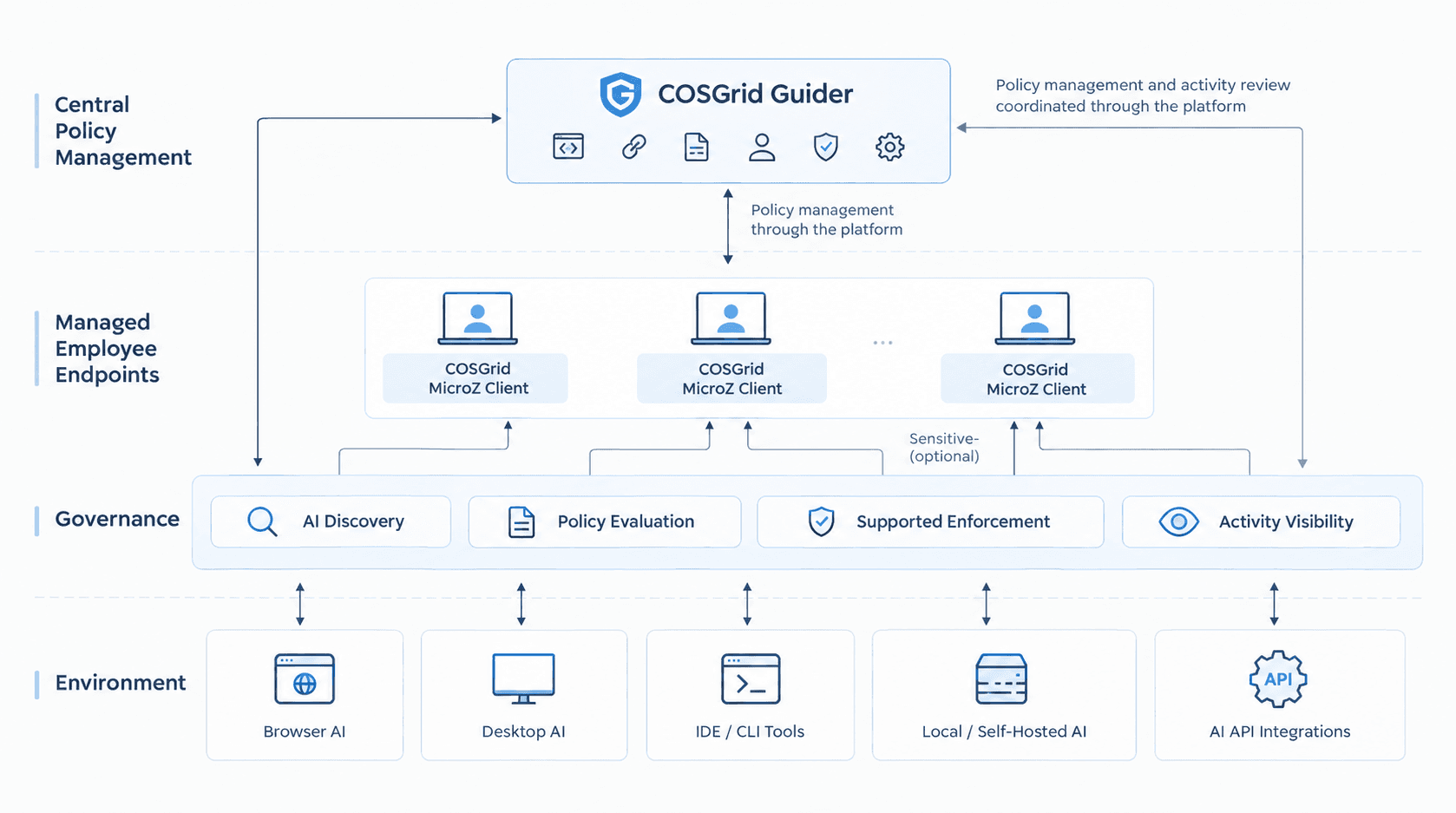
TrustShield AI brings together endpoint visibility, AI application discovery, governance policies, supported enforcement controls, and centralised activity monitoring.
COSGrid Guider
COSGrid Guider provides the central management interface for configuring and managing supported TrustShield AI policies and reviewing available activity information.
COSGrid MicroZ Client
The COSGrid MicroZ Client provides the endpoint component for supported TrustShield AI capabilities. It helps provide visibility into AI-related activity and enforce configured controls within the supported endpoint environment.
AI Application Discovery
TrustShield AI helps identify AI applications and tools in use within its supported visibility scope. This can help organisations understand where AI is being used across browser-based applications, desktop AI tools, developer environments, and other supported AI usage channels.
AI Governance Policy Engine
Governance policies help organisations determine which AI tools and usage patterns are permitted, require monitoring, or should be restricted, according to supported policy options.
AI Related Data Protection
Where the relevant capabilities are available and enabled, TrustShield AI can support controls intended to reduce the risk of sensitive information being exposed through supported AI interactions.
Outbound API Monitoring
TrustShield AI supports visibility into supported outbound API usage and related integration activity to help security teams identify potential exposure paths and risky usage patterns.
Activity Visibility
Available governance and activity information helps administrators review AI-related usage, investigate relevant events, and evaluate policy behaviour.
04 — AI GOVERNANCE WORKFLOW
How Does COSGrid TrustShield AI Work Step by Step?
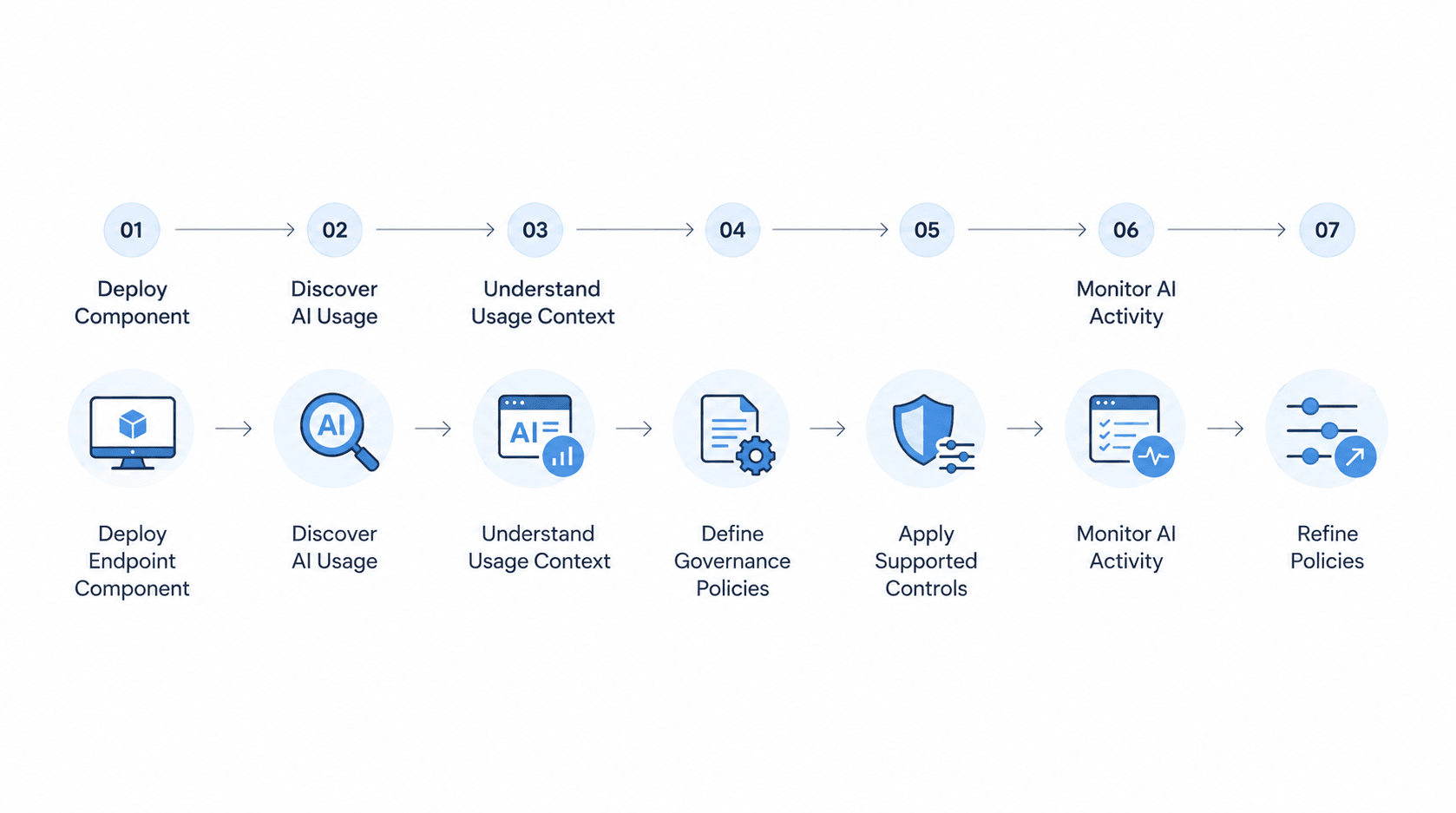
Step 1: Deploy the Endpoint Component
Deploy the COSGrid MicroZ Client to the managed endpoints included in the TrustShield AI deployment.
The endpoint component provides the foundation for supported visibility and enforcement capabilities within the configured environment.
Step 2: Discover AI Applications and Usage
TrustShield AI helps identify AI applications and related tools in use within the supported visibility scope.
This can help security teams understand how employees interact with AI tools through supported browser applications, desktop applications, developer environments, and other supported channels.
Step 3: Understand the AI Usage Context
Review discovered AI tools and relevant available activity to understand which applications are being used and where additional governance may be needed.
This helps administrators distinguish approved AI usage from activity that may require further review under organisational policy.
Step 4: Define AI Governance Policies
Configure policies according to organisational requirements. Policies can establish how supported AI applications and usage patterns should be handled.
Depending on the available capabilities, policy outcomes can include monitoring, warning users, or blocking supported activities.
Step 5: Apply Governance Controls
The configured policies are applied through the supported TrustShield AI deployment and enforcement mechanisms.
Approved use cases can continue according to policy, while activities that violate configured restrictions can be handled using the applicable supported action.
Step 6: Monitor AI-Related Activity
Use available activity information to review AI usage, examine policy outcomes, and investigate relevant events.
Where supported, review AI-related data protection and outbound API activity to identify potential exposure paths.
Step 7: Refine Policies Over Time
Use operational findings to adjust governance policies as the organisation adopts new AI tools, changes its risk requirements, or identifies additional use cases requiring oversight.
05 — SHADOW AI DISCOVERY
How Does TrustShield AI Help Discover Shadow AI?
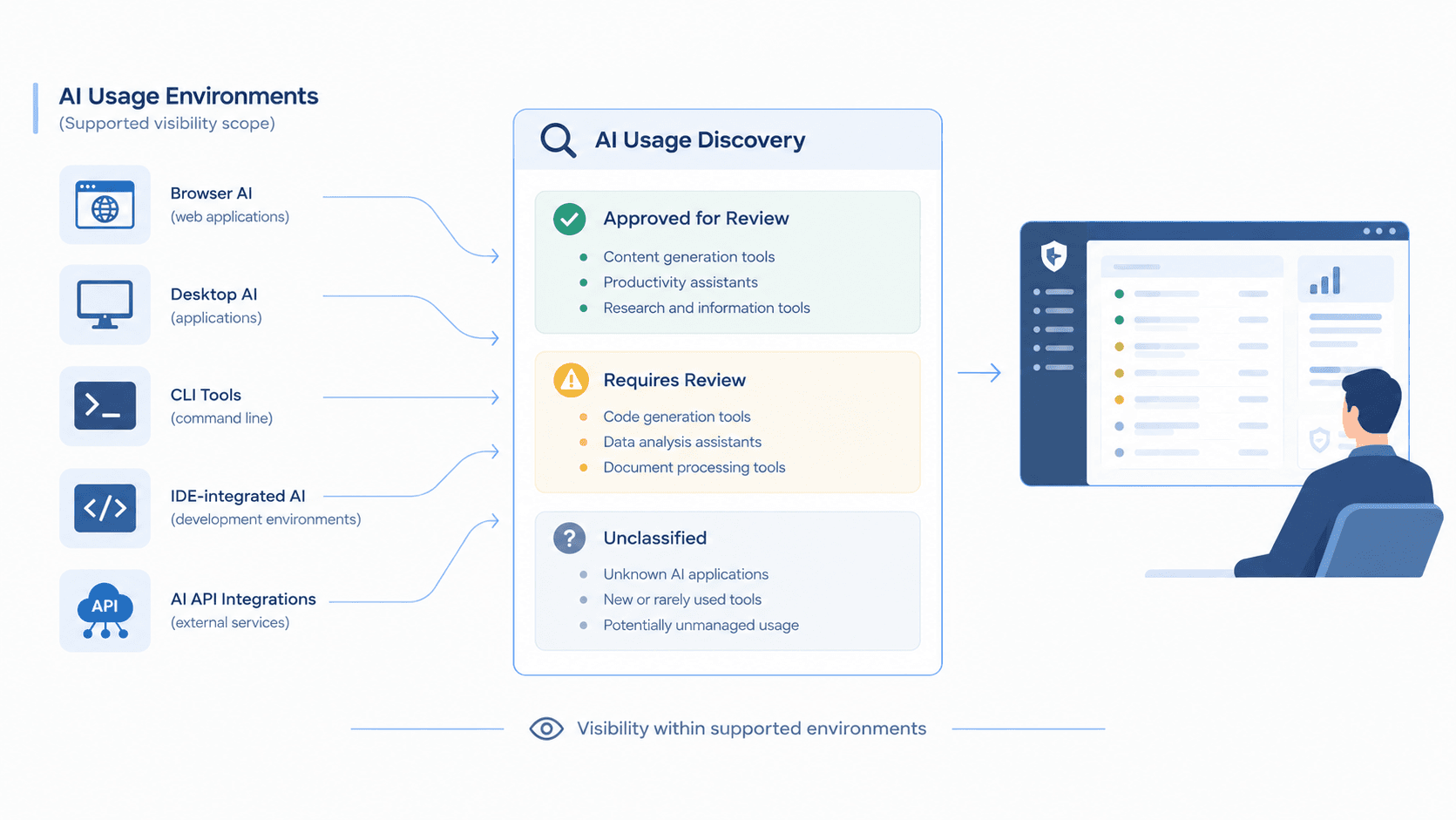
Shadow AI refers to the use of AI applications, services, or integrations without appropriate organisational visibility or governance.
Employees may independently adopt AI tools for writing, research, coding, document analysis, or productivity. These tools may not be part of the organisation's formally approved technology stack.
Without adequate visibility, security teams may struggle to determine which AI tools are being used and whether their use aligns with organisational requirements.
COSGrid TrustShield AI helps organisations discover AI applications and related usage within its supported visibility scope.
Identify AI Tools in Use
Gain visibility into supported AI applications and related tools used within the managed environment.
Identify Potentially Unmanaged Usage
Use available discovery information to identify AI tools that may require review or approval under organisational policy.
Understand Usage Across Supported Environments
Discover supported AI usage across browser applications, desktop AI tools, developer environments, and other supported AI channels.
Inform Governance Decisions
Use discovered information to determine which tools should be approved, monitored, warned against, or restricted according to supported policy options.
Shadow AI discovery helps organisations make more informed decisions about AI adoption without relying solely on employee declarations or manual inventories.
06 — AI APPLICATION ACCESS CONTROL
How Does TrustShield AI Govern AI Application Access?
Not every AI application is suitable for every business environment. Organisations may need to distinguish between approved enterprise AI tools, personal AI accounts, and applications that have not been authorised for business use.
TrustShield AI helps organisations apply governance policies to supported AI application access.
Establish Approved AI Usage
Define which supported AI tools or access scenarios are permitted under organisational policy.
Identify Unapproved AI Activity
Use available discovery and activity information to identify supported AI usage that may not align with the approved application policy.
Apply Appropriate Policy Actions
Depending on supported capabilities and configuration, administrators can apply governance actions such as monitoring, warning, or blocking relevant AI application activity.
Review Policy Outcomes
Use available activity information to assess whether the configured controls are operating as intended and identify areas requiring policy refinement.
This approach helps security teams introduce clearer governance over AI application usage while allowing approved business use cases to continue.
07 — AI-RELATED DATA PROTECTION
How Does TrustShield AI Help Reduce Sensitive Data Exposure?
AI tools can process text, documents, code, and other information supplied by users. If sensitive business information is submitted to an inappropriate AI service, an organisation may face data exposure and governance risks.
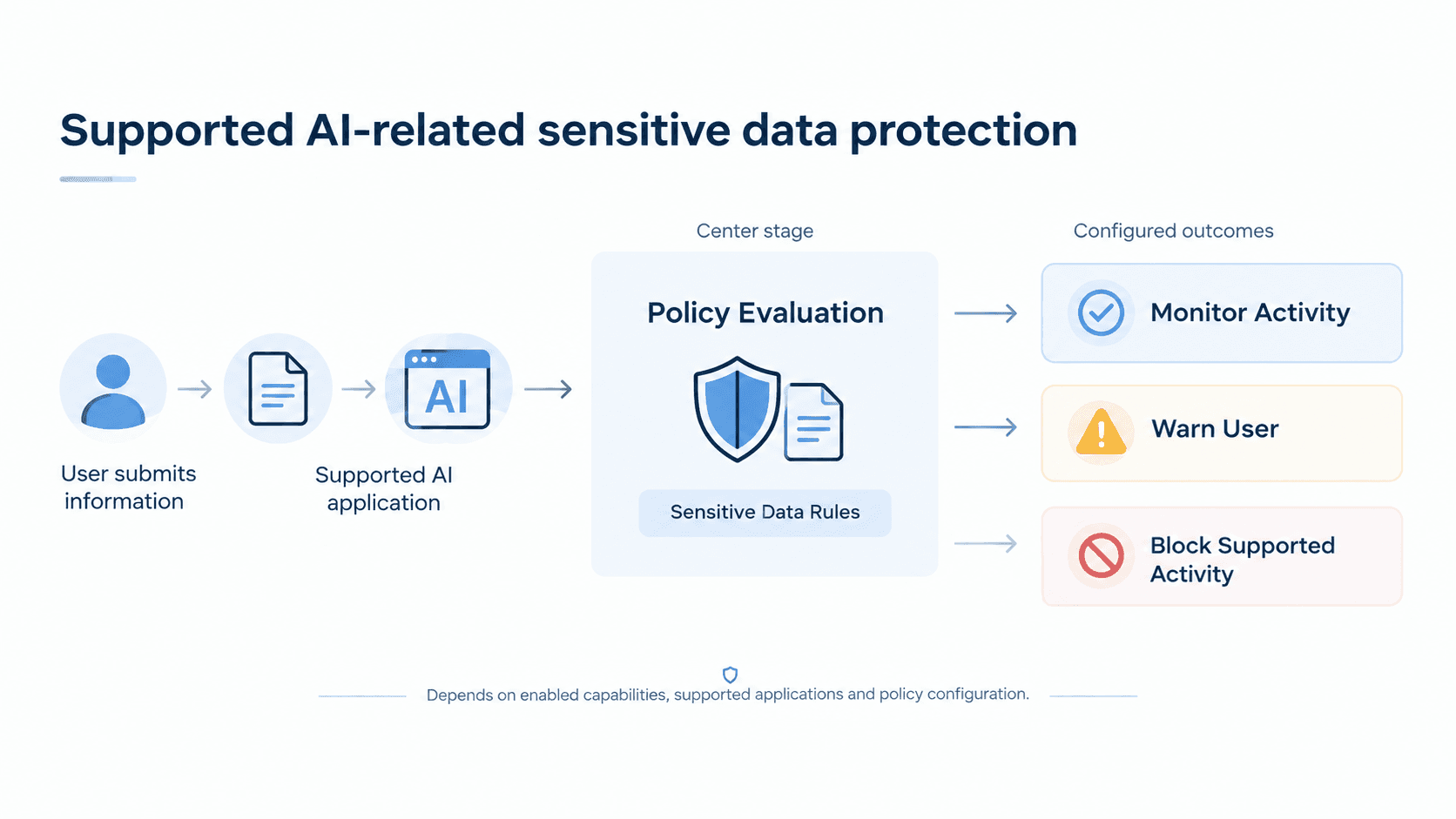
TrustShield AI is designed to support AI-related data protection within its supported capabilities, helping organisations apply governance controls to relevant AI usage.
Establish Data Protection Requirements
Define the sensitive information categories and AI usage scenarios that require additional controls.
Apply Supported Detection Policies
Where AI data protection and sensitive data detection capabilities are enabled, configure the applicable policies for supported AI interactions.
Apply the Configured Action
Depending on the supported capability and policy configuration, relevant activity can be monitored, users can be warned, or the activity can be blocked.
Review Relevant Events
Use available activity and policy information to review relevant events and refine governance requirements.
AI-related data protection can help organisations reduce the risk of sensitive information being exposed through supported AI workflows. Its effectiveness depends on the supported application, the available inspection mechanisms, policy configuration, and the deployment environment.
08 — AI APPLICATIONS AND USAGE ENVIRONMENTS
Where Can TrustShield AI Help Govern AI Usage?
AI usage extends beyond standalone browser applications. Employees and developers may interact with AI through multiple environments, each presenting different visibility and governance requirements.
TrustShield AI is designed to address supported AI usage environments, subject to application coverage and deployment capabilities.
Browser-Based AI Applications
Help discover and govern supported AI tools accessed through web browsers.
Desktop AI Applications
Manage supported AI application usage on managed endpoints where the relevant application and enforcement capabilities are available.
CLI-Based AI Tools
Address supported command-line AI usage within the available endpoint visibility and control scope.
IDE-Integrated AI
Help govern supported AI tools integrated into developer environments, according to available discovery and enforcement capabilities.
Local and Self-Hosted AI
Support visibility and governance for local or self-hosted AI environments where the relevant detection and control mechanisms are available.
AI APIs and Integrations
Monitor supported outbound API usage and related integration activity to help identify potential exposure paths or risky usage patterns.
09 — OUTBOUND API MONITORING
How Does TrustShield AI Help Monitor AI API Usage?
AI-related activity may involve third-party APIs, developer tools, automated workflows, and application integrations. These connections can introduce risks if they are unmanaged or used in ways that do not align with organisational policy.
TrustShield AI supports monitoring of supported outbound API usage to help security teams understand relevant AI-related connections and potential exposure paths.
Identify Supported API Activity
Gain visibility into outbound API usage covered by the deployed monitoring capabilities.
Review Integration Context
Examine available information about relevant API usage and integrations to identify activity that may require further investigation.
Identify Potential Exposure Risks
Use available monitoring information to investigate potential data exposure paths, risky integrations, or credential-related concerns where supported by the product's detection capabilities.
Inform Governance Decisions
Use the findings to refine policies, investigate suspicious activity, and establish appropriate controls for supported integrations.
Outbound API monitoring helps extend AI governance beyond the browser interface, providing additional context for organisations whose AI usage includes developer tools and integrations.
10 — GOVERNANCE ACTIONS
How Does TrustShield AI Respond to AI Usage?
AI governance requires more than discovering applications. Organisations also need a way to apply decisions to supported AI activities.
TrustShield AI supports governance actions according to its available policy and enforcement capabilities.
Monitor
Observe supported AI usage and review relevant activity to understand how applications are being used.
Warn
Provide a warning for supported activity when the configured policy calls for user notification.
Block
Prevent supported activity that violates a configured policy where blocking enforcement is available for the relevant application and activity.
These actions help organisations apply different levels of governance according to the risk and business requirements.
For example, an organisation may initially monitor a newly discovered AI tool, warn users when its use requires review, and block activity that falls outside an established policy.
The actual response depends on the supported application, the policy configuration, and the enforcement capabilities available in the deployment.
11 — POLICY MANAGEMENT AND MONITORING
How Are TrustShield AI Policies Managed?
TrustShield AI supports a policy-based approach to governing supported AI usage.
Define Governance Requirements
Identify the AI applications, usage scenarios, and risks that require controls.
Configure Policy Actions
Select the supported policy outcome, such as monitoring, warning, or blocking, based on the organisation's requirements.
Apply Policies to the Supported Environment
Deploy the configured controls through the available TrustShield AI management and endpoint enforcement mechanisms.
Review Activity
Use available activity information to understand AI usage and examine relevant policy outcomes.
Refine the Governance Approach
Update policies as the organisation's AI usage, security requirements, and approved applications evolve.
A consistent policy workflow helps security teams establish a repeatable process for governing AI usage while retaining flexibility for legitimate business requirements.
12 — EXAMPLE USER JOURNEY
TrustShield AI in Action: Governing Employee Use of AI
Consider an organisation where employees use generative AI for writing, research, and productivity. The security team wants to understand which tools are being used and reduce the risk of employees submitting sensitive business information to unapproved AI applications.
Here is how TrustShield AI can help:
- Deploy the endpoint component: The organisation deploys the COSGrid MicroZ Client to the managed endpoints included in the deployment.
- Discover AI usage: TrustShield AI identifies supported AI applications and related activity within the available visibility scope.
- Review discovered tools: The security team evaluates which applications align with the organisation's approved AI usage requirements.
- Configure governance policies: Administrators define the appropriate actions for supported AI applications and usage scenarios.
- Apply controls: The deployed solution enforces supported monitoring, warning, or blocking actions according to the configured policies.
- Review relevant activity: Security teams examine available events and monitoring information to investigate potential policy violations or exposure risks.
- Refine governance: Policies are updated as approved tools, employee workflows, and organisational requirements change.
Where AI-related sensitive data detection is enabled and supported, the organisation can also apply the relevant policies to covered AI interactions.
This workflow helps transform AI usage from a largely unmanaged activity into a more visible and policy-governed process.
13 — COMMON USE CASES
Where Can COSGrid TrustShield AI Be Used?
Shadow AI Discovery
Identify supported AI applications and usage that may not be covered by existing organisational approval processes.
Enterprise AI Application Governance
Establish policies for approved and restricted AI applications within the supported enforcement scope.
AI Usage Monitoring
Review supported AI activity to improve visibility into how AI tools are being used across the organisation.
Sensitive Data Protection for AI Workflows
Apply supported AI-related data protection policies to help reduce sensitive information exposure where the required capabilities are enabled.
Developer AI Governance
Address supported AI usage through CLI tools, IDE-integrated AI, and developer workflows, subject to application coverage and available enforcement.
AI API and Integration Oversight
Monitor supported outbound API usage and investigate relevant integrations that may introduce security or data exposure risks.
AI Governance in Regulated Environments
Support internal AI governance processes by providing visibility, configured controls, and available activity information. Regulatory compliance depends on the organisation's complete control framework and operational practices.
14 — KEY BENEFITS
What Does TrustShield AI Help Organisations Achieve?
Greater AI visibility: Discover supported AI applications and usage within the available visibility scope.
Shadow AI awareness: Identify potentially unmanaged AI tools that may require governance review.
Policy-based AI access: Apply supported controls to AI application usage according to organisational requirements.
Sensitive data protection: Help reduce exposure risks in supported AI workflows where the relevant data protection capabilities are enabled.
Broader AI usage coverage: Address supported browser, desktop, developer, local AI, and API environments according to deployment capabilities.
Operational oversight: Review available activity information to investigate relevant events and refine policies.
Structured AI governance: Establish a repeatable process for discovering AI usage, configuring controls, and reviewing policy outcomes.
15 — FREQUENTLY ASKED QUESTIONS
Frequently Asked Questions About COSGrid TrustShield AI

What is COSGrid TrustShield AI?
COSGrid TrustShield AI is an AI Governance solution designed to help organisations discover supported AI application usage, manage AI access policies, and monitor relevant AI-related activity. It helps security teams address Shadow AI and apply governance controls within the supported deployment scope.
How does COSGrid TrustShield AI work?
TrustShield AI uses the supported endpoint and management components to provide visibility into AI usage, apply configured governance policies, and make relevant activity available for review. The specific controls depend on the supported application and deployment configuration.
What is Shadow AI?
Shadow AI refers to AI applications, tools, or services used without appropriate organisational visibility, approval, or governance. It can create risks when employees use unapproved tools or handle sensitive information without suitable controls.
How does TrustShield AI help discover Shadow AI?
TrustShield AI helps identify supported AI applications and related tools within the available visibility scope. Security teams can use this information to review AI usage and determine which tools require approval, monitoring, or restrictions.
Which AI applications does TrustShield AI support?
TrustShield AI is designed to address supported AI usage across browser-based AI applications, desktop AI applications, CLI tools, IDE-integrated AI, local or self-hosted AI, and AI API integrations. Exact application coverage and enforcement capabilities should be confirmed for the deployed version.
Can TrustShield AI block unapproved AI applications?
TrustShield AI supports governance actions such as monitoring, warning, and blocking where the relevant enforcement capability is available. Blocking depends on the application, activity, policy configuration, and supported deployment.
Can TrustShield AI help prevent sensitive data from being submitted to AI tools?
TrustShield AI is designed to support AI-related data protection within its supported capabilities. The ability to detect or block particular sensitive information depends on the enabled detection features, supported application, and configured policy.
Does TrustShield AI monitor AI API usage?
TrustShield AI supports monitoring of supported outbound API usage and related integration activity. The information available for investigation depends on the deployed monitoring capabilities and supported environment.
Is TrustShield AI the same as COSGrid DLP?
No. TrustShield AI and COSGrid DLP are separate products. TrustShield AI focuses on AI governance and supported AI-related protection scenarios, while COSGrid DLP focuses on endpoint data protection across its supported Windows endpoint channels.
Is TrustShield AI the same as COSGrid CASB?
No. COSGrid CASB focuses on supported SaaS application visibility, account-access controls, and file-transfer policies. TrustShield AI focuses on AI governance and supported AI-related activity. The products have distinct scopes.
Does TrustShield AI guarantee compliance with AI regulations?
No product can independently guarantee regulatory compliance. TrustShield AI can support an organisation's AI governance and data protection processes, but compliance depends on its policies, deployment, configuration, operational practices, and applicable legal requirements.

